Political storm in Argentina over a MacBook Air

May 24, 2008

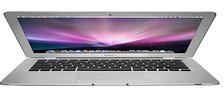
apple-macbook-air-2.jpgSeveral argentinean newspapers (link in Spanish) have reported on a MacBook Air gifted by Mexican billionaire Carlos Slim to Argentina’s president Cristina Kirchner. This is apparently creating a large controversy as the product is perceived as a luxury item. As a result, the presidency will create a public official gift registry to avoid any suspicions of corruption. This is certainly a good initiative implemented in many countries rocked by similar scandals in the past. However, in general the controversy was created over much pricier gifts like the diamonds that African dictator Bokassa gave to French president Valery Giscard d’Estaing back in the 70’s.

What really surprises me is to see how Apple products have become a symbol of luxury recently. I am sure that everyone remembers for example the gold plated iPod that David Beckham received from his team mates. I have seen many CEOs of large enterprises be the single Mac users of their company. For example, I know that Ricardo Salinas Pliego, CEO of Grupo Salinas and one of the wealthiest men in Mexico uses a Mac. At Banorte, one of the large Mexican banks, and probably the fastest growing one, there are only two Mac users. However, those users have a lot of weight as they are the CEO and the Director of Marketing.

What does that mean for the future of the Mac in large companies? Well, it means that the IT staff has no option but to learn how to use those computers and support them. That opens a new market for Apple. It also means that it is becoming harder for IT departments to adopt solutions that exclude the Mac. This is not good news for Microsoft and it could help companies like IBM or Oracle that have developed collaboration solutions that are truly platform independent. Many open-source advocates have long criticized Apple for their proprietary approach to computing. It is time for them to recognize that Apple is helping their cause very strongly by forcing the adoption of open standards.

The iPhone opens new opportunities for OSX Server

May 19, 2008

83848B8C-D4BC-4CB1-8A00-3AEB614F969A.jpgThe iPhone is already a popular product in the US, but it will become much more popular, specially in the enterprise, once Apple releases version 2.0 of the iPhone OS. With the new software companies will be able to easily distribute custom build applications to their employees using a special version of the iTunes App Store.

While not much is known about this application, it is a pretty safe guess to assume that it is Mac OS X only and that it will probably included in an upcoming release of OS X Server. While such a strategy may help Apple sell a couple of hundred servers, it is hard to believe that Apple doesn’t have larger ambitions in the telephony market, specially for small and medium sized businesses.

Asterisk is a popular open-source application that is already widely used on Linux servers. It is used to create cheap telephony solutions that used to cost hundreds of thousands of dollars. The solution is an open source/free software implementation of a telephone private branch exchange (PBX). Like any PBX, it allows a number of attached telephones to make calls to one another, and to connect to other telephone services including the public switched telephone network (PSTN). With Asterisk it is easy to setup voice mail boxes and route calls to home numbers or cell phones.

Asterisk also supports a wide range of Voice over IP protocols, including SIP, MGCP and H.323. It can interoperate with most SIP telephones, acting both as registrar and as a gateway between IP phones and the PSTN. This makes Asterisk a perfect complement to iChat.

Apple has a long history of including open-source applications with OS X Server, making them easy to configure and manage. The OS already includes products such as the Apache Web Server or the MySQL database server. So why not include Asterisk? It would allow Apple to offer a turnkey solution for small to medium companies. Imagine a server that costs less than US$ 5,000 and offers everything that this market needs, from e-mail to instant messaging, from wikis to video conferencing, and now with a true unified communications solution. I am sure it would quickly become an instant hit.

What is required to make this happen? Asterisk already runs on OS X, so all Apple really needs to do is to integrate it better with the OS and offer the required analog phone and E1/T1 interfaces for the XServe. Additionally they will need to port iChat to Windows (this is long overdue). On the business side, they will also need to improve their VAR network as these solutions cannot be simply sold at the Apple Store, they need to be supported by IT professionals.

None of these hurdles seem too hard to overcome. I really believe that Apple will eventually offer such a solution, with an announcement coming maybe as soon at WWDC. After all, at the event there is an Information Technologies track designed for IT professionals who support Mac networks and many of those attending it would likely be very interested by such an announcement. The iPhone is Apple’s key to get the Mac into the Enterprise and Asterisk can make it happen in a really big way.

WWDC is sold out

May 14, 2008

wwdc08badge_small_soldout.pngLast year over 5,000 persons attended WWDC. At the time it represented a new record for the annual Apple developer event. The result was fueled by the imminent launch Mac OS X Leopard. This year, with 25 days to go before Steve Jobs addresses developers at the keynote speech, Apple has announced that for the first time ever, the conference has sold out.

I am sure that most do not realize the significance of this announcement. In the past, Apple has used many dirty tricks to artificially increase the number of attendants to WWDC. For example, there used to be a separate conference for Quicktime content creators. I believe that Apple cancelled that event two years ago and folded it within WWDC. Last year there was a session track for web developers, presumably to pave the way for new web applications targeting iPhone users. The result was that if you engaged in conversation with people you didn’t know you were likely to find out that they had absolutely no clue about Objective-C or Xcode.

This year things are likely to be quite different. Apple no longer needs tricks to fill Moscone West up. Gone are the tracks for web developers and video content creators. There still is a track for System Administrators but the rest of the sessions are designed exclusively for developers. This means that even if attendance only grows to six thousand (the Convention Center was already packed last year), this will still represent a very significant increase in the number of real programmers attending the event. It is a clear sign that many of those 200,000 persons who downloaded the iPhone SDK are actually using it and want to be prepared for the launch of the app store at the end of June. This is going to be the best WWDC ever!

Globalization

May 13, 2008

logo_en.gifEveryday you hear about globalization. It just seems that every single day our earth is becoming smaller and smaller. Global brands like Coca-Cola, McDonald’s and Starbucks are found everywhere. People all over the world are complaining that nations are losing power and independence. They claim that all important decisions are now taken at a supra-national level (this is specially true in the EU). But is it really true? Sometimes I wish it were. You see, I am Dutch but I was raised in Switzerland, attended college in France and Spain before getting my first job in Canada. I now happen to live in Mexico, but as many other things in life this is due to circumstances, and circumstances may change. That means that for me, as well as a growing group of people who have become used to live all around the world, the nation system doesn’t make much sense anymore. It simply places too many artificial barriers that make life ridiculously complex when it doesn’t need to be.

Despite all the talk about globalization, most of the changes that have happened over the last decades have mainly impacted corporations. At the individual level there are still many barriers protecting nations which make the life of people like myself difficult. I think that these barriers can easily be grouped in three kinds, commercial, financial and legal.

The commercial barriers are starting to crumble. It is becoming very difficult to limit the sale of a product to a single country or region or use differentiated pricing policies around the world. The gray market which quickly appears when artificial product availability and pricing is introduced by the manufacturer is taking care of the problem in most cases. However, there are still important issues impacting global consumers where I feel totally unprotected. One case is for example DVDs. The introduction of regions makes it impossible for me to buy a Spanish Blu-Ray disk because it will simply not play on my American PlayStation 3. The same happens with console games. Music is another sector that needs to be liberated. It doesn’t make any sense that I can easily buy a French CD from Amazon.fr but that I cannot buy from the French Apple Store. The problem is that I do not feel that anyone is fighting for the global consumer. We really need someone to pick that fight for us. These issues should be discussed at an international level, for example by the WTO.

On a financial level, I strongly believe that individuals deserve more freedom. We should be allowed to easily open a bank account anywhere in the world. Don’t get me wrong, I am not trying to avoid paying taxes, I just want to move my money where I can get the best returns. I would love to invest in the US through online brokerage companies like e-trade, but I can’t. It doesn’t matter if I have access to all the required information to find interesting investment opportunities. Because of all the legal barriers imposed to individuals, there is no way for me to invest in Serbia for example, now that they are moving closer to joining the EU. I would love to sell Euros and buy Dollars now that it is clear that the current exchange rate is taking a terrible toll on the European industry and that the ECB will have to lower rates, but that is not going to happen either because I cannot have an Euro denominated account in Mexico, despite being a customer of a global bank based in Europe. That drives me crazy. I do understand that if we liberalize the financial system this could be a great opportunity for drug lords and other evildoers to abuse the system, but I still believe that something needs to be done to help individuals take their financial decisions freely. Moving exclusively to electronic currency could be the solution to start eradicating crime and allow for more (supervised) financial freedom.

The legal front is the most complex and where more work is required. Taxation and retirement benefits for example are regulated by law and represent a major issue that countries have been trying to solve through bilateral agreements. However, if there is no such agreement in place you may be out of luck. Say for example that you worked 40 years in total, 20 in one country and 20 in a different country. You may qualify for retirement in any of those countries after working for 30 years, but if there is no agreement to recognize the years worked in the other country you may end up not qualifying for benefits in neither country. In general laws are still designed to protect citizens who live and die in their home country. This simply does no longer represent the current situation of an increasingly large population group and inadecuate laws are reducing worker mobility. If countries are serious about attracting talent they must make sure that situations like the one I described are avoided.

The problem is in many ways cultural, people are not used to this new situation. Most people still expect your nationality to describe you. However, those traveling to France will be very disappointed if they expect to only see white people wearing bérets and carrying baguettes under their arms on the streets of Paris. The world has changed. You would expect large Internet companies like Yahoo or Google to understand the problem, after all their reach is global, right? Wrong. They still assume too often that because someone connects from a certain country they are citizens of that country and that they behave in a predictable way. For example, when I connect to the US Yahoo main page from Mexico I get an ad for the Mexican soccer section (I couldn’t care less for Mexican soccer). When I connect to Google from Brazil, I get my search results in Portuguese. When I try to see the goals scored by Real Madrid on marca.com, I am denied service because I am connecting from outside of Spain. All this is simply ridiculous. Of course, I have the option to fight back, I can use a proxy server in the US or in any other country to fool the system, but why should I have to? This happens to some degree even in the US. That is why a device like the slingbox has become popular. People want to see their home team games while on travel. Consumers demand freedom and they will ultimately get it, even if they have to bend the rules.

I do not expect changes to happen quickly. Politicians do not have any incentive to help people like me. For starters, we do not live in our home country and too often we do not vote or represent a political force. Besides, the issue is complex and international cooperation is needed to solve the many problems that I have briefly outlined. As usual, governments are playing catch-up with the social issues that are grappling the world. Globalization is happening and not just at the corporate level. Governments need to adjust to a new reality and they need to do so very quickly because the amount of people who are becoming global citizens is growing exponentially and we are increasingly asking for solutions to our new problems. However, this issue needs also to be tackled by corporations who need to work with a new kind of customers who expect truly global service from global companies.


It is already hard to find hotel rooms near Moscone for WWDC

April 19, 2008

7B1040F8-2A5F-4BCC-AF90-349420CF608A.jpgToday I booked my hotel room for WWDC. I had read on MacBidouille that this year hotel rooms would be harder to get due to a large unspecified convention taking place the same week as WWDC. I still thought that I was safe though, as I was making a reservation seven weeks in advance. Well, I was wrong. Hotels are indeed at full capacity near Moscone West. In the past I had no trouble making reservations at the San Francisco Hilton or the Park 55 hotel, but this year I had no luck, even after checking many other options in the same price range.

So, what this means for me is that this year WWDC will be unexpectedly expensive. For the first time, I will stay at the San Francisco W Hotel. Since I will arrive on my birthday, I will consider it like a very nice present. However, I swear that next year I will make reservations well in advance. There simply is no way I will pay those outrageous rates once more. On the bright side, I do not believe that this problem is only caused by the fact that another convention is taking place at the same time as WWDC. I am quite sure that attendance will be significantly up this year and that the event will be a lot of fun.

PayPal’s decision to stop supporting insecure browsers is positive for the industry

April 18, 2008

safari.jpgEarlier today, Ryan Naraine reported for eWeek that “PayPal, one of the brands most spoofed in phishing attacks, is working on a plan to block its users from making transactions from Web browsers that don’t provide anti-phishing protection”. The reason behind this decision is that “browsers that do not have support for blocking identity theft-related Web sites or for EV SSL (Extended Validation Secure Sockets Layer) certificates are considered ‘unsafe’ for financial transactions”.
This announcement has generated a lot of concern among Mac users since Safari, the most widely used browser on that platform does not support EV SSL. Even though I do use Safari as my main browser on both Mac and Windows, I do agree with the decision. The reason is simple, even though it is very simple to avoid phishing attacks on any computer by just pointing your DNS information to OpenDNS, few know how to do it or even understand how phishing works. Those who complain about the decision are obviously not aware of the size of the phishing attacks and the amount of fraud they represent. If PayPal‘s decision forces Apple to implement EV SSL support into Safari, I will certainly not complain. It is great to have a fast and standards compliant browser, but security for the technologically challenged users should be a major concern for Apple.

However, there are more reasons to back PayPal‘s decision. Too many users are still using old browsers and this his slowing down the adoption of new technologies. I would love to see more companies to stop supporting old versions of Internet Explorer or Netscape Navigator. That would really give web developers an opportunity to create great innovative applications. Right now, people too often prefer to use those old versions because there are still sites that require them. If large sites start requiring newer browser versions, those old sites will face increased pressure to modernize. That cannot be bad for the industry or the end-users.

Buying a WWDC ticket in Mexico is an ordeal

April 16, 2008

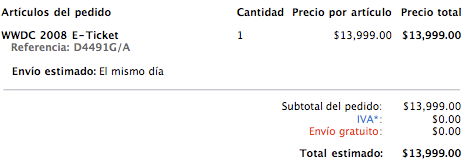
7B1040F8-2A5F-4BCC-AF90-349420CF608A.jpgOnce again I am having trouble to register for WWDC. Last year my problem was that I couldn’t buy the ticket through the online Apple Store because there simply was no Mexican Apple Store. In the end I could solve the problem by using a mail forwarding address that I have in the US. This year I expected to be able to register quickly since Apple finally opened their online store south of the border. Well, it seems that I was overly optimistic. Everything went fine until I actually paid for the e-ticket. As you can see, the estimated total cost was 13,999 pesos, which is a fair price based on the current exchange rate. Note that there are no taxes (IVA) which makes sense since this is an event that takes place in the US.

Picture 2.png

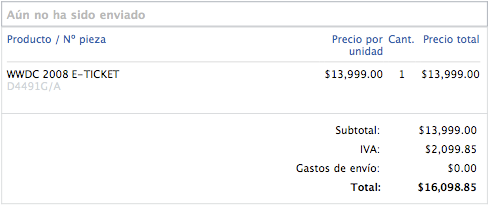
Since I did not receive an e-mail confirmation, I decided to check the status of my order. I was shocked to see that the amount of my order was now MXP16,098.85 or MXP2,099.85 more than I expected to pay. The difference is caused by a 15% tax. This has to be a mistake because the Mexican government does not collect taxes on services provided in another country. Otherwise, I would also have to pay taxes in Mexico when booking a hotel room in the US which is simply ridiculous.

Picture 1.png

I obviously called the Apple Store to solve the problem. As expected nobody had complained about that problem before and the person who tried to help me didn’t understand the problem immediately. It took me a while to explain why this product shouldn’t cause taxes but once he saw the discrepancy he asked me to hold while he asked his supervisor for help. After a couple of minutes he told me that his supervisor was not available and that he would call me back. He hasn’t. Since using a mail forwarding address doesn’t work anymore, I will have to call him back tomorrow to try to solve the problem. Frankly, I am not happy about this situation.

I already knew that Apple is definitively not a global company. They focus mainly on the US and a couple of major markets in Europe and Asia. They seem to be unable or unwilling to grow elsewhere. Just look at the iPhone fiasco. It has almost been a year since the product was launched in the US and it is only available in five additional countries. If you happen to live outside of one of the chosen countries you are out of luck. Developers in Brazil, Russia, India and China are left in the cold. It doesn’t matter that their economies are growing fast, Steve doesn’t care. You may think that there aren’t many Mac or iPhone developers in those countries, and who knows, you may be right. I still believe that nobody should be excluded. After all, popular Mac software like The Print Shop or Kid Pix Deluxe are developed by Software MacKiev, a company based in Ukraine, a country which, unsurprisingly, has no Apple Store.

Microsoft retail stores could be successful

April 12, 2008

7B6E6AAE-0A7B-4E60-B769-06410C2C7811.jpgI just read an editorial on The Mac Observer in which John Martellaro writes that Microsoft Retail Stores would fail. He bases his conclusion on the poor reception Vista has had in the market so far, specially among consumers, and the fact that Microsoft seems to have lost interest in that segment of the population.

I totally disagree. For starters, Microsoft currently produces one of the most successful consumer electronics device, the XBox 360. Microsoft could easily fill up any Apple Store just with Xbox 360 games and accesories. Then there is the Zune. Sure, that MP3 player isn’t nearly as sexy as the iPod touch but I could see more people buying it if it were properly showcased. Microsoft could also sell phones based on Windows mobile made by their hardware partners. Those phones are certainly not state of the art but they (almost) work as advertised and appeal to a segment of the population. Microsoft also produces some PC hardware that includes keyboards and mice which are quite popular. And then obviously there is software, Windows and Office of course, but let’s not also forget that there is much more, like the Microsoft Expression Suite which is a decent collection of products and finally highly popular PC games like Age of Empires or Flight Simulator. So, the perception that Microsoft does not have products that are compelling for consumers is totally wrong.

People also tend to assume that Microsoft would be unable to match the Apple shopping experience. I am not sure what they mean by that. Sure, Apple’s sales force tends to be nice and knowledgeable but having run a small chain of Apple retail stores for three years about ten years ago, I know that this is relatively easy to achieve when you only handle a small number of SKUs. The secret of Apple’s success has to be found somewhere else. You want to know what it is? Easy. People go to the Apple Store because it is usually one of the only stores in the mall that appeals to men (although not exclusively), and because there is free internet access. That was the genius behind choosing malls to open stores. People usually don’t go to Best Buy or Fry’s to just hang out, instead they go to a mall where there are more entertainment and food options. And where do men go when they are tired of watching the women apparel that their wives or girlfriends want to buy? That’s right, they go to the Apple Store. WHy? Because there simply aren’t many other options (and it could get even worse if The Sharper Image goes out of business.

There is a reason that explains why Apple hasn’t yet opened stores in Germany, France or Spain. Those countries haven’t embraced the retail shopping mall model like the US, the UK or even Mexico. It has to do with expensive and scarce real estate in downtown areas where affluent people use to shop. In those countries you may find malls in the suburbs but they will usually not house luxury or premium brands. You could argue that not all Apple Stores are located in malls, and you would be right. In fact all flagship stores (San Francisco, New York, Chicago. Tokyo and London) are on busy streets, but only major markets support that model. The problem is finding great locations for smaller stores. Nothing prevents Apple to open a flagship store on the Champs Élisées in Paris or Serrano in Madrid but where does Apple grow from there if there are no (suitable) malls?

Apple has great products but analysts and Apple enthusiasts must understand that many of those who enter the company stores do it often simply because of a lack of better options. That is great for Apple because it generates a disproportionate amount of foot traffic, but most of those people would probably welcome a little competition. I love Apple but I also like to spend some time at a Sony store, specially if the alternative is spending time at Zara or Coach. I am sure that if Microsoft decides to open new retail stores and like Apple places them in malls, they will be able to get a fair share of that traffic. Wether Microsoft deserves it or not is a different matter.

Notes from Vegas

April 8, 2008

las_vegas.jpgYesterday evening I was invited to have dinner at a chinese restaurant, Wing Lei,located inside the Wynn Hotel and Casino. It was a great occasion to spend some time with our customers and talk about all things unrelated to business. I must say however that I was highly disappointed by the restaurant. While I do not have any complaints about the service, I must say that I expected more from a restaurant that was awarded a star by the Guide Michelin. We paid around US$200 per guest and left disappointed and hungry.

Since the Wynn is located in front of the Fashion Show Mall, I spent some time shopping there before dinner. I went into the Apple Store to buy new earbuds for my iPhone because the plastic had started to wear off near the jack connector due to intense use. I was surprised to see that they sent me immediately to the Genius Bar and that they gave me new earbuds without asking questions despite the fact that it was clear that my phone was jailbroken and unlocked. Great customer service! That is why Apple is winning the hearts of even the most diehard Windows users.

Geneva public education system dumps Windows, will use Linux

April 6, 2008

GenevaLinux.pngIn my previous post I wrote about my years at Collège Calvin. I have fond memories of Geneva, but I particularly cherish those years. It was at this high-school that I met my first girlfriend, Karine and it was also there that I worked on my first mini computer. The system was built by Prime Computer that was running an OS that vaguely resembled UNIX, which is not surprising once you know that some of the company founders had previously worked at MIT on Multics. The sys-admin was particularly proud of the two 5GB hard disks that he had named Castor and Pollux. At the time that was a lot of capacity but students still had to buy 8” floppy drives to store their own data as disk space was severely restricted for regular accounts. Despite its flaws, the system was cutting edge in 1981, specially if we consider the fact that all public high schools were part of the network. Students used the system to learn assembly language, Pascal, Fortran and Modula-2 programming. As a result, Geneva has produced many great developers who have continued their education at world class institutions like the EPFL or the University of Geneva. One of the best known Mac developers of that generation is Antoine Rosset, creator of OsiriX, who I met a couple of times through a common friend. He seems to be back in Geneva after living a couple of years in the bay area like another of my friends Pierre Demartines.

The fact is that Geneva has always invested a lot in education and I will always be grateful for that decision. I am happy to see that this tradition goes on. I was reading one of the local papers yesterday (La Tribune de Genève) when I saw this article (in French) that talked about the local government decision to dump Windows in favor of Linux (Ubuntu) on about 9,000 PCs in public schools. Athough Geneva is not the first canton (state) in Switzerland to take this decision, that honor goes to Solothurn (or Soleure in French) which took the same decision one month earlier, it is still a very significant step forward that others will probably follow in the near future. Good for them!

Loading more posts...

© 2026 Huibert Aalbers. All rights reserved.

Contact Me